The design was approved. Then came "one tiny change." Then another. And another. Three days later you're still on the same piece and you can't remember what the original version was. Nobody got paid for that time.
Revisions are normal and necessary. The problem is when they have no limit and no order. Here's how to handle them so your client stays happy and your margin stays intact.
Correction or new request: the difference that saves you
The most useful rule for any agency is to separate these two things:
- Correction: something that doesn't match what was requested. A typo in a price, a color that isn't the brand's, a missing detail. It always gets fixed, no argument.
- New request: something that changes what was requested. A different offer, a different product, a different angle, "let's do a video instead of a flyer."
A correction is part of the job. A new request is additional work. Once your client understands the difference, most conflicts disappear.
Why the brief decides the revisions
If the brief says "2x1 promo on acrylic nails, Friday and Saturday" and the design says exactly that, the work was done right. If the client now wants a 3x2, that's not a correction. That's why the brief should be in writing and confirmed. We explain how to put one together in how to get a brief from your client.
How we handle revisions behind your agency
When we produce for you, the flow is simple:
- We produce based on the brief you sent us.
- We deliver the piece to you.
- You present it to your client under your brand.
- If they ask for adjustments, you send them to us all together, in one message.
- We adjust and send you back the new version.
We never talk to your client directly. Corrections go through you, and that gives you control: you can filter, group and clarify before anything reaches production.
Bundling all the changes into one message saves more time than anything else. Five changes together are one revision; five separate changes are five revisions.
How to set limits without sounding harsh
Your client shouldn't feel like you're charging for every comma. They should feel there's an order to things. A few lines that work:
- "Send me all your adjustments together and I'll get it back to you as soon as possible."
- "This changes the original promo. I'll prepare it as a new piece so we don't lose the one you already approved."
- "For this to go out on time Friday, I need your final approval on Wednesday."
- "This change means redoing the design. I'll quote it separately or we can include it in next month's calendar."
What to include in your proposal
Define from the start how changes work. You don't need a lawyer-drafted contract; it's enough to make it clear in writing:
| Item | Example of how to say it |
|---|---|
| Corrections | Anything that doesn't match the approved brief gets fixed |
| Adjustments | Minor copy or color tweaks within the same piece |
| Changes in direction | Treated as a new piece |
| Approval deadline | The client approves before the agreed date so the post goes out on time |
| How to send changes | All together, through a single channel |
Social media has an advantage: with Professional Brand, designs are unlimited, so a new request isn't always an extra cost for you. But it still needs order so it doesn't stall the calendar.
What an extra revision costs
Think of every round of changes as time. Your time to read, filter and pass along the adjustments, and production time to redo the work. If a piece goes through five rounds, that work was multiplied by five and your client paid the same. With one client it's a nuisance; with fifteen, it's the reason your agency isn't making money.
That's why order isn't a whim. It's what keeps your margin healthy and leaves you time to land new clients instead of fixing the same designs over and over.
Signs something is going wrong
- The client asks for changes on pieces that were already published.
- Every piece goes through more than three rounds.
- Changes come in by voice note, WhatsApp, email and phone calls all at once.
- Nobody remembers which version was approved.
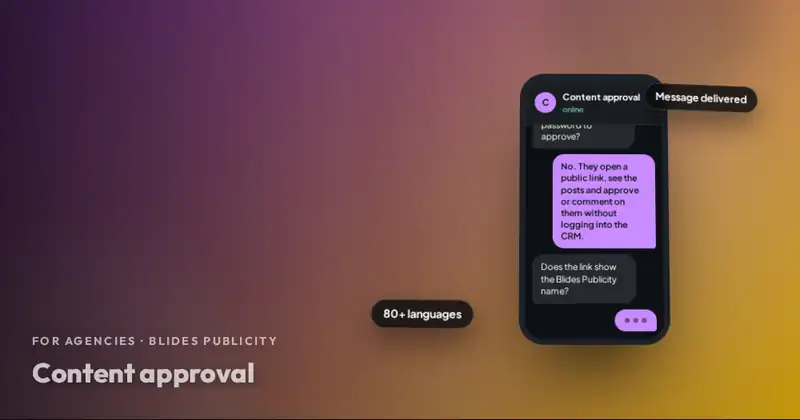
If this sounds familiar, the fix is almost always the same: a clearer brief and a single place to approve. For social media, the content approval link brings a lot of order to this process.
Do you have an agency or work on your own? We are your production team.
You sell and bill under your brand; we handle social media, ads, websites, AI and support at agency pricing. Your client never knows we are behind it.
Close the loop
Well-managed revisions make you look professional. Unlimited revisions cost you money and patience. Separate corrections from new requests, bundle the changes and put dates on approvals. We take care of producing and adjusting; you keep the relationship with your client.
Frequently asked questions
How many revisions are included when I produce with Blides?
We fix anything that doesn't match the brief. Changes in direction are treated as a new piece; for social media with unlimited designs, that's handled within the calendar.
What do I do if my client changes their mind after approving?
Explain that the approved version stays saved and the change will be prepared as a new piece. That way nothing that was already done gets lost.
Can I send you the changes as voice notes?
You can, but it's better to summarize them in writing in a single message. That way no detail gets lost and the revision comes out right the first time.